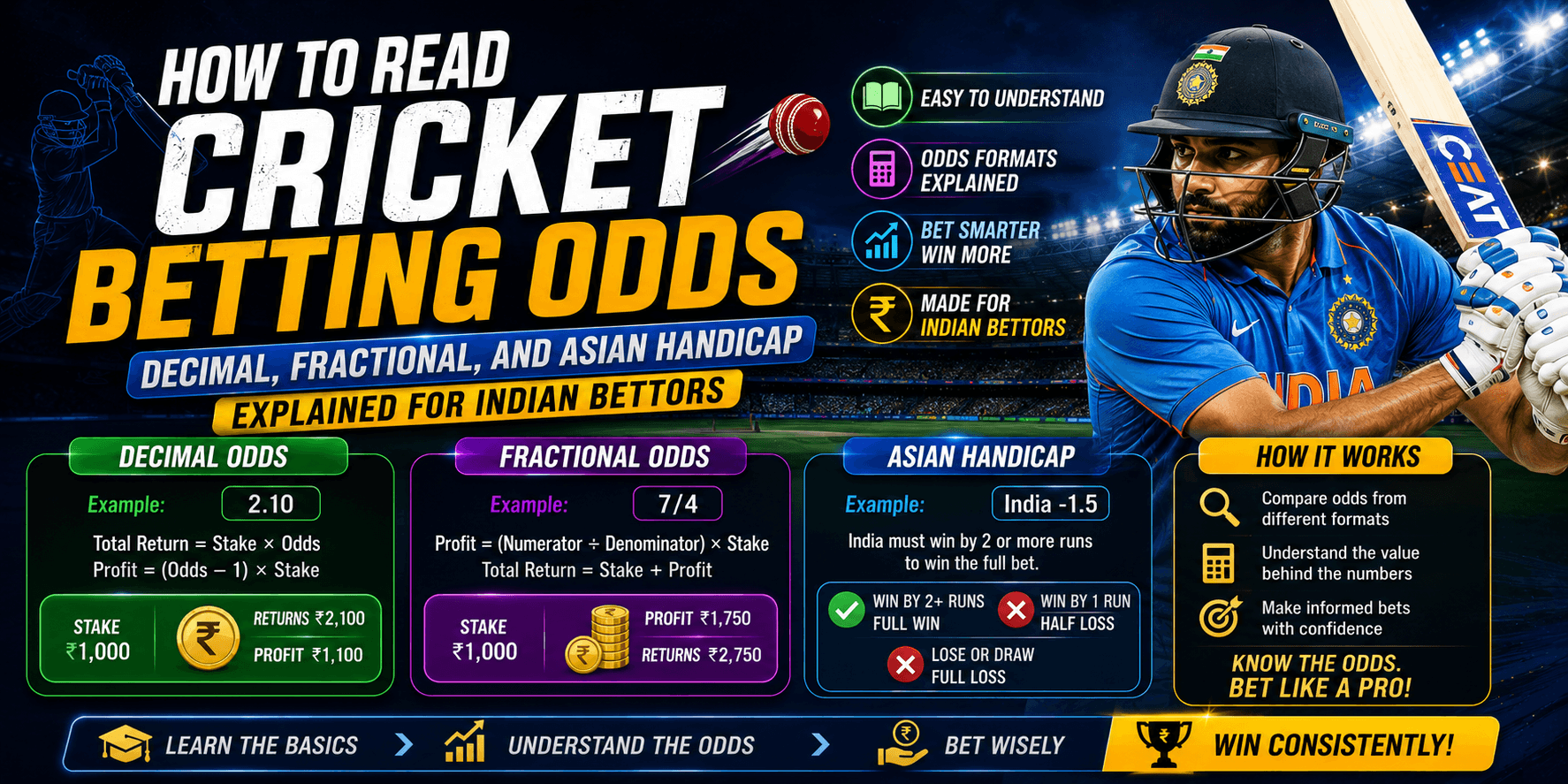
Numbers on a betting screen can look intimidating the first time. There's a team name, a string of digits next to it, and no obvious explanation of what any of it actually means. Yet those numbers carry all the essential information a bettor needs: probability, potential return, and the market's collective opinion of how a match is likely to go. Once the logic behind them clicks, reading cricket betting odds becomes second nature. This guide breaks down the three most common odds formats, decimal, fractional, and Asian handicap, from the very beginning. No prior knowledge is assumed, and every concept is explained with examples drawn directly from cricket. By the end, any bettor, whether new to the markets or looking to sharpen an existing understanding, will have a clear, working grasp of how odds function and how to use them in cricket match prediction.
The Relationship Between Odds and Probability in Cricket Match Prediction
Before getting into the formats themselves, it helps to understand what odds are actually doing. At their core, odds represent probability. Every outcome in a cricket match, which team wins, who takes the first wicket, what happens on the next ball, has some likelihood attached to it. Odds are a bookmaker's or exchange's way of translating that likelihood into a number that also tells the bettor how much they stand to receive if the outcome goes their way.
This is why odds and cricket match prediction are inseparable. A bettor who forms their own view of a team's chances, based on squad news, recent form, pitch conditions, and head-to-head records, is essentially generating their own probability estimate. Comparing that estimate against what the odds imply is where informed betting decisions come from. It's not about gut feel. It's about whether the market's implied probability matches what the evidence actually suggests.
Decimal Odds: The Cleanest Format to Start With
Decimal odds are the most widely used format on Indian betting platforms, and they're the easiest to understand because the maths involved is minimal.
The decimal number shown next to a team or outcome represents the total return per unit staked, and that total includes the original stake. So the profit is always the decimal number minus one, multiplied by the stake.
Here's how that plays out in practice. If India is listed at 2.40 to win a T20 match, a bettor placing ₹500 on them would receive a total return of ₹1,200 if India wins (2.40 × ₹500). The profit on that bet is ₹700, with the original ₹500 returned as part of the payout.
Some more examples to make the pattern clear:
Odds of 1.80 on a ₹1,000 stake returns ₹1,800 total, profit of ₹800. Odds of 3.50 on a ₹500 stake returns ₹1,750 total, profit of ₹1,250. Odds of 1.25 on a ₹2,000 stake returns ₹2,500 total, profit of ₹500.
The pattern is consistent: the bigger the decimal number, the bigger the return relative to the stake, but also the less likely the outcome is considered to be.
Converting Decimal Odds to Implied Probability
To convert any decimal odds figure into an implied probability, divide 1 by the decimal number and multiply by 100. This gives the percentage chance the market believes the outcome has.
Odds of 2.00 → 1 ÷ 2.00 × 100 = 50%. Odds of 1.60 → 1 ÷ 1.60 × 100 = 62.5%. Odds of 5.00 → 1 ÷ 5.00 × 100 = 20%.
This conversion is one of the most practically useful skills in cricket match prediction. If a bettor thinks a team has a 70% chance of winning and the decimal odds imply only 55%, the odds are undervaluing that team. That's where value can be found.
Fractional Odds: The Traditional Format, and How It Works
Fractional odds are older and originate from British betting culture. They're still used on some platforms and appear occasionally in cricket markets, so understanding them is worth the effort even if decimal odds are the everyday format.
Fractional odds express profit only, not total return. The number on the left shows the profit earned per the number on the right staked.
So 4/1 (said as "four to one") means: for every 1 unit staked, the profit is 4 units. The original stake is returned separately on top of the profit. A ₹500 bet at 4/1 would return ₹2,000 profit plus the ₹500 stake, for a total of ₹2,500.
Odds of 3/2 mean: for every 2 units staked, the profit is 3 units. A ₹1,000 bet at 3/2 returns ₹1,500 profit plus ₹1,000 stake, total of ₹2,500. Odds of 1/5 mean: for every 5 units staked, the profit is 1 unit, a heavy favourite with a small return.
When the left number is larger than the right (like 5/1 or 7/2), the selection is the underdog and the returns are generous. When the left number is smaller than the right (like 1/3 or 2/5), the selection is a strong favourite and the profit is modest.
Moving Between Fractional and Decimal Formats
Converting fractional odds to decimal is a simple calculation: divide the fraction and add 1. So 4/1 = (4 ÷ 1) + 1 = 5.00 in decimal. Odds of 3/2 = (3 ÷ 2) + 1 = 2.50 in decimal. Odds of 1/5 = (1 ÷ 5) + 1 = 1.20 in decimal.
Once a bettor can move between formats, switching between different platforms that display odds differently stops being a source of confusion. The underlying value of the bet is exactly the same in both representations, it's just displayed in a different way.
Asian Handicap: The Format That Levels the Field
Asian handicap is the most nuanced of the three formats, but it was created to solve a genuine problem in betting: what happens when one team is so clearly better than the other that the odds are almost meaningless? Or when two teams are so evenly matched that choosing one feels arbitrary?
Asian handicap solves both problems by giving one team a virtual advantage before the match begins. In cricket, this most commonly takes the form of a run-line market, where one team starts with a run advantage or deficit.
Here's a basic example. India vs Sri Lanka, with India listed at -20.5 runs and Sri Lanka at +20.5 runs. A bet on India at -20.5 means India must win by more than 20 runs for the bet to pay out. A bet on Sri Lanka at +20.5 means Sri Lanka either wins outright or loses by 20 runs or fewer. The .5 in the handicap is intentional, it removes the possibility of a tie on the bet, so every bet either wins or loses cleanly.
When the handicap is a whole number, like -20 rather than -20.5, a push becomes possible. If the winning margin is exactly 20 runs, the handicap bet is void, and the stake is returned to the bettor. This is a key distinction from the half-number versions.
Quarter Handicaps, The More Sophisticated Version
Quarter handicaps like -0.25 or +1.75 introduce another layer. These work by splitting the stake across two adjacent handicap lines. A bet at -0.25 means half the stake goes on the team at 0 (where a draw returns the stake) and the other half on the team at -0.5 (where a draw loses). The result is a partial return in draw outcomes rather than a full win or full loss, it softens the risk slightly.
Quarter handicaps are most commonly found on exchange platforms like FairPlay cricket exchange, where market depth and competitive pricing allow for more specific handicap options. The FairPlay cricket exchange operates on a peer-to-peer model, matching bettors against each other, which means the handicap markets there tend to carry sharper prices than what standard bookmakers list.
How Odds Work Across Different Cricket Match Prediction Markets
Understanding the formats is one part of the picture. Knowing how odds behave across different types of markets is the other part. Match winner odds are the most liquid, meaning more money flows through them, and they reflect the most collective opinion. Cricket toss prediction markets tend to sit close to even (around 1.90 to 1.95 in decimal), and while the randomness of the toss itself makes them harder to find value in, understanding how the toss result affects the match is important context for other markets.
Player-specific markets, top scorer, and leading wicket-taker carry longer odds and more variance. They require detailed form research and an understanding of conditions. Tracking cricket highlights from recent matches is useful here, because visual observation of player form, how a batter is moving at the crease, and whether a bowler's rhythm looks sharp adds texture that raw statistics don't always carry.
Using Odds Effectively on FairPlay Cricket
Knowing how to read odds is most useful when combined with a platform that presents them clearly and across a full range of markets. FairPlay cricket is built for exactly this kind of engagement. FairPlay cricket betting covers match winner markets, in-play options, player bets, and cricket toss prediction markets, all displayed in the bettor's preferred odds format. Switching between decimal and fractional is straightforward within the platform.
For bettors who want to go further, the FairPlay cricket exchange gives access to handicap markets and peer-to-peer pricing across all major tournaments. Because the exchange doesn't build a bookmaker's margin into its odds, the prices available there are consistently closer to true probability, which makes the conversion calculations covered in this guide even more rewarding when applied.
Getting a cricket betting ID in India on a platform like FairPlay cricket is the practical first step toward putting odds knowledge to use. The registration process, basic personal details, identity verification, and a payment method are quick, and once done, all markets and odds formats become immediately accessible. For anyone serious about informed betting, the best online cricket betting app in India should display odds in multiple formats, update them in real time as match conditions evolve, and carry a wide enough range of markets to make every format, decimal, fractional, and Asian handicap, genuinely usable. FairPlay cricket covers all of these requirements in one place.
Conclusion
Reading cricket betting odds doesn't require a background in mathematics. Decimal odds show the total return per unit staked. Fractional odds show profit relative to the stake. Asian handicap levels the playing field and opens up more nuanced markets where the match context matters as much as the raw team quality. All three formats express the same underlying idea, the relationship between probability and potential return, just in different ways. The bettor who understands that relationship is in a far better position to make considered cricket match prediction decisions rather than reactive ones. Getting a cricket betting ID in India, using a reliable platform like FairPlay cricket betting, and taking the time to read odds properly, in whichever format feels most natural, is what separates genuinely informed betting from guesswork.
FAQ's
1. What is the simplest odds format to learn first?
Decimal odds are the most accessible starting point. The number shown represents the full return per unit staked, including the original stake, which makes the calculation immediate and easy to apply.
2. What is the difference between decimal and fractional odds in cricket betting?
Decimal odds show the total return, while fractional odds show only the profit. Odds of 4.00 in decimal are the same as 3/1 in fractional, both return the same amount, just expressed differently. Converting between them is straightforward once the logic is understood.
3. How does Asian handicap work in a cricket match?
Asian handicap assigns one team a virtual run advantage or deficit before the match starts. A bet on the favoured team with a -15.5 handicap requires them to win by more than 15 runs. A bet on the other side at +15.5 pays out if they win outright or lose by 15 or fewer runs.
4. Why do odds matter for cricket match prediction?
Odds represent the market's implied probability for each outcome. In cricket match prediction, comparing that implied probability against a bettor's own research-based estimate is how value is identified, and value is the foundation of any long-term betting approach.
5. What is the FairPlay cricket exchange, and how is it different from a bookmaker?
The FairPlay cricket exchange is a peer-to-peer platform where users bet against each other rather than against the platform. This results in sharper odds because there's no bookmaker margin built in, only a small commission on winning bets.
6. Are cricket toss prediction markets worth betting on?
Cricket toss prediction markets sit close to even odds in most cases. Their value lies less in the market itself and more in understanding how the toss result affects other markets, particularly at venues where dew significantly changes second-innings conditions.
7. How do cricket highlights help a bettor understand odds?
Cricket highlights provide visual context for player form and match conditions that statistics don't always capture. A bettor who regularly watches highlights from recent matches is better placed to assess whether current odds fairly reflect a team's or player's actual state of form.
8. What is a cricket betting ID in India?
A cricket betting ID in India is a registered account on a legitimate betting platform. It requires a sign-up process with identity verification and a payment method. Once active, it gives access to all markets, including live odds and exchange betting.
9. Can a bettor use all three odds formats on the same platform?
Most established platforms, including FairPlay cricket betting, allow users to select their preferred odds format within the app settings. This means switching between decimal, fractional, and other formats doesn't require moving between different platforms.
10. What makes the best online cricket betting app in India suitable for learning to read odds?
The best online cricket betting app in India should display odds clearly, allow format switching, update prices in real time, and carry a range of markets, including handicap options through the FairPlay cricket exchange, so that all three odds formats are genuinely usable within one platform.