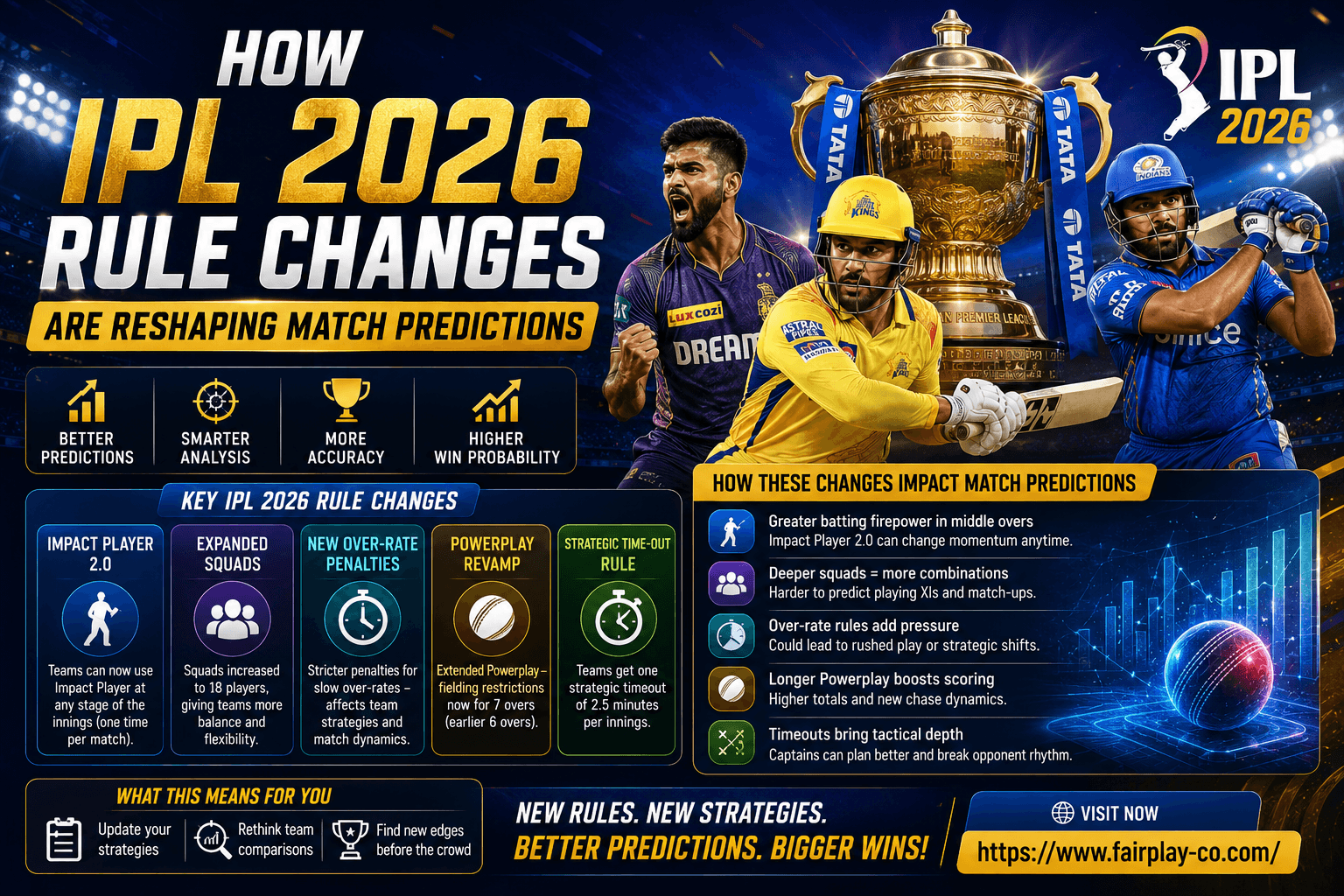
IPL rule changes in 2026 did not arrive as a dramatic overhaul. The BCCI confirmed before the season that the tournament would retain the landmark rules introduced in recent seasons - the Impact Player Rule, the Two Team Sheets Rule, DRS for wides and no-balls, and the Smart Replay System. What changed is how these rules have matured in their application. Teams have now had two to three seasons to build strategies around them, and the ripple effects on match structure, squad selection, and live odds movements have become more pronounced rather than less. Understanding each rule - what it actually allows, and what it has done to how IPL 2026 matches unfold - is the foundation of any serious IPL strategy for predictions and betting.
What Are the Key IPL 2026 Rule Changes?
The BCCI's pre-season captains meeting on March 25, 2026, confirmed the rules governing IPL 2026. Three are most relevant for IPL match predictions and the live betting markets that follow from them. Each one changes something specific about how matches are structured, how teams are built, and how information becomes available before and during play.
The Impact Player Rule
The Impact Player Rule, introduced in IPL 2023 and retained through at least 2027, allows each team to nominate five substitutes at the toss. One of those five can be used as an Impact Player during the match - brought in at the start of an innings, after a wicket, at the end of an over, or at the innings break. The Impact Player bats or bowls as a full member of the team, not as a limited substitute. An overseas player can only be used as the Impact Player if the team has fewer than four overseas players in the playing XI, which means the rule primarily benefits Indian specialists.
The Two-Team Sheets Rule
The Two Team Sheets Rule allows captains to bring two different playing XIs to the toss and finalise their selection after the coin is flipped. A team that wants to bat first on a flat track can bring one XI. If they lose the toss and are asked to bowl, they can switch to an alternate XI with an extra bowling option. This rule fundamentally changed the information available at the toss - the team winning the toss now knows their own final XI immediately, while the opponent does not confirm theirs until after seeing the toss result.
DRS for Wides and No-Balls Rule
DRS for wides and no-balls, retained from IPL 2025, allows teams to review decisions on both wide calls and front-foot no-balls using the Decision Review System. This change has reduced obvious officiating errors and made DRS usage more strategically significant, since a team that burns a review on a boundary call has less protection against a clear edge or LBW later in the over.
How the Impact Player Rule Changes Match Prediction
The Impact Player Rule is the single most significant T20 cricket rules change in IPL history for IPL match predictions purposes. Its effect on IPL 2026 data is measurable and direct.
The most visible change is in batting depth. Every team functionally bats twelve players when the Impact Player Rule is used to bring in an additional batter, removing the traditional trade-off between batting and bowling depth. Teams can now carry an extra specialist opener, knowing the Impact Player can cover any bowling gap that is created. The IPL 2026 powerplay run rate of 10.47 per over, confirmed by CricViz, is partly a product of batting lineups that simply could not have existed before this rule.
For IPL match predictions, treating the starting XI as the full picture is a mistake. The Impact Player nomination can add a seventh specialist batter or a fifth bowler, depending on the match situation - information that only becomes visible at the toss. Any prediction model that does not account for the five nominated substitutes is working with an incomplete team sheet.
The second effect is on bowling load management. RCB have used the Impact Player Rule specifically to protect Bhuvneshwar Kumar from the death overs in low-pressure passages, reserving him for the phases where his economy of 7.40 matters most. [IPL bowling statistics and player prediction analysis] that ignores how Impact Player usage shapes bowling rotations is missing one of the most tactically significant variables of IPL 2026.
How the Two-Team Sheets Rule Affects Toss Prediction
The Two Team Sheets Rule creates a specific live betting window that did not exist before IPL 2026. Before this rule, both XIs were confirmed before the toss, so post-toss odds reflected complete information on both sides. Now, the toss-losing team is still selecting their XI in response to the result - meaning the exchange price is adjusting to a team sheet that has not yet been fully announced.
Teams have applied this most effectively at venues where the toss is highly predictive. At Chepauk, a team winning the toss can immediately finalise their batting-first XI while the opposition decides which bowling combination suits a chasing scenario on that surface. At Wankhede and Chinnaswamy, the toss winner locks in their bowling-first lineup instantly while the opposition adjusts.
The practical implication for IPL strategy on live toss markets is direct. The toss-winning team's XI is confirmed information. The toss-losing team's XI is still being decided during the window between toss and ball one. [IPL toss betting strategy and venue analysis] connects to exactly this window - where FairPlay's exchange prices, shaped by cricket betting consensus, are most likely to lag what the actual match conditions imply.
Betting Strategy to Build Around IPL 2026 Rule Changes
Understanding the rules produces specific betting strategies, not just general awareness. Here is how each rule change translates into a concrete IPL strategy for predictions.
Impact Player and Session Markets
Because the Impact Player rule adds batting depth to every team, session lines in IPL 2026 should be set against a higher baseline than pre-2023 seasons. A powerplay line of 55 that would have been aggressive in 2021 may be conservative against a team deploying an Impact Player specialist opener. Before any powerplay session bet, check which of the five nominated Impact Players could be used as an aggressive batting option in the second innings - this tells you whether the team's batting ceiling is higher than the starting XI suggests.
Two Team Sheets and Post-Toss Live Markets
The most direct application of the Two Team Sheets Rule is in the two-to-five-minute window between the toss announcement and the toss-losing team confirming their final XI. During this window, betting platforms' exchange prices are still adjusting to the toss result. A bettor who has already assessed which XI each team would select in each toss scenario - batting first versus chasing - can act before the confirmed XI is announced and before the exchange price fully reflects what the team selection actually means for the match odds.
DRS for Wides and No-Balls in Death Over Markets
The DRS for wides and no-balls rule has a specific effect on death over betting markets. Bowlers who previously relied on the occasional uncalled wide as a form of run control now face a higher standard of accuracy. IPL 2026 data shows that deaths over economies have dropped marginally compared to the previous season, despite the overall run rate explosion - partly because bowlers have adjusted their lines to avoid DRS-reviewable wides. For fall-of-wicket and total runs markets in overs 17-20, this tighter bowling accuracy means the extreme scoring outliers that appeared in pre-DRS seasons are less common. Session lines in the death overs are more reliable as prediction inputs now than they were before this rule was introduced.
How to Apply These Insights to FairPlay
The IPL rule changes in 2026 create specific, identifiable windows where live exchange prices lag what the match information actually implies. FairPlay's peer-to-peer exchange is where these windows are most actionable because prices reflect bettor consensus rather than a central bookmaker model - meaning the adjustment to new information is driven by individual bettors acting, not by a pricing team updating a spreadsheet.
For any playoff match, the pre-first-ball window after the toss is the highest-information moment available. The toss-winning team's XI is confirmed. The Two-Team Sheets Rule means the toss-losing team's selection is still being finalised. The Impact Player nominations for both sides are announced. Combining all three inputs against the venue's powerplay average and death over economy produces a prediction framework that is more complete than anything available in any pre-2026 season. FairPlay covers all remaining IPL 2026 playoff matches with ball-by-ball live markets and UPI deposits from ₹300.
Final Thoughts on IPL Rule Changes and Match Prediction
The IPL rule changes in 2026 have not made match prediction harder - they have made it more specific. The Impact Player Rule adds a variable that batting lineup analysis must account for. The Two Team Sheets Rule creates a post-toss information window that live bettors can act on. DRS for wides produces tighter death over bowling and more reliable session line data. Each rule change is a signal that the market has not always priced correctly - and for bettors who understand what each rule actually does, that mispricing is where the IPL strategy advantage lies in the playoff stage.