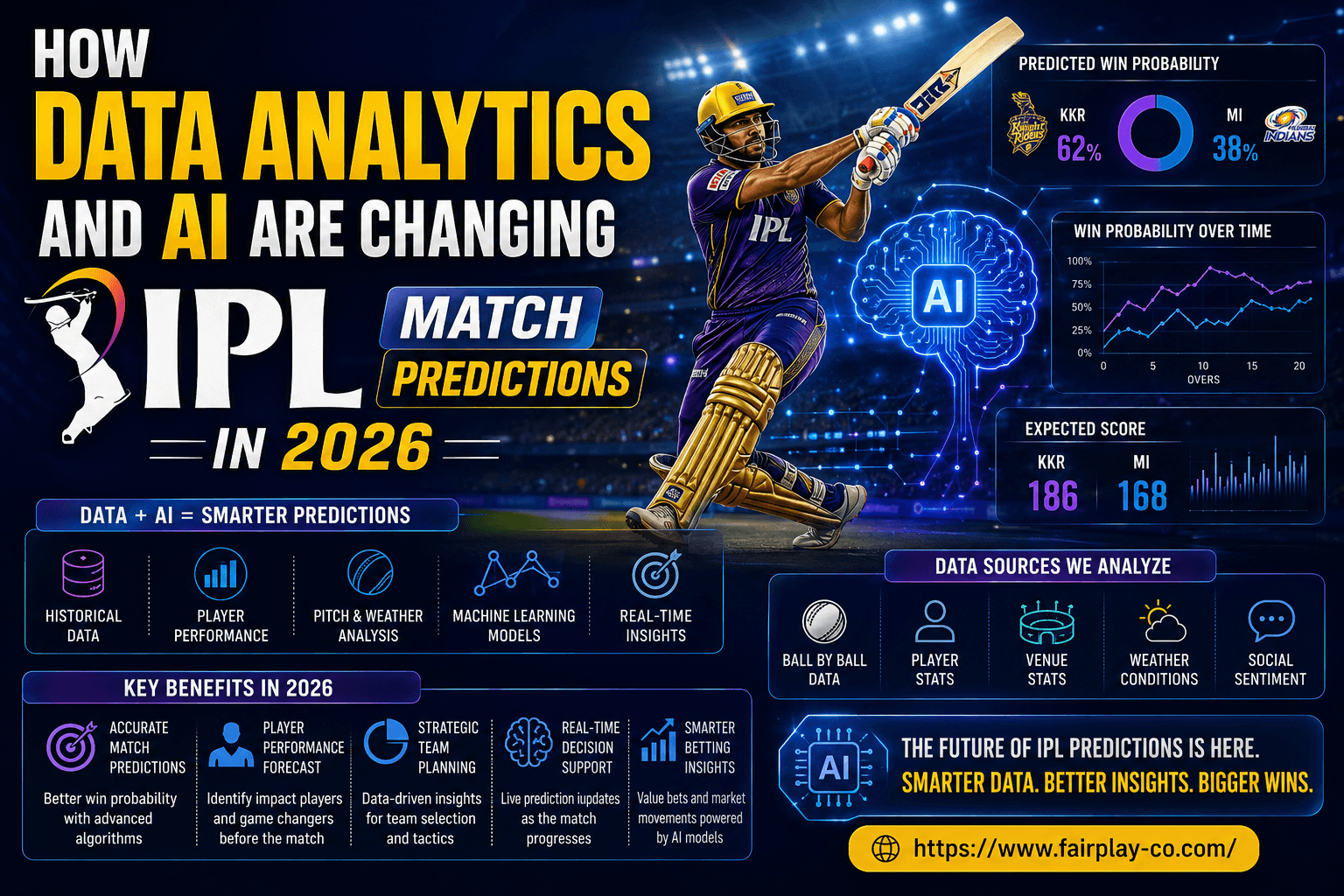
IPL match prediction has moved well beyond gut feeling and strike rate comparisons. In 2026, every IPL franchise runs on a stack of machine learning models, real-time sensor data, and analytics platforms that process thousands of variables per delivery. What was once the exclusive territory of coaching staff and sports scientists is now influencing how bettors read matches, how platforms price live odds, and how the game is understood in real time. This article explains what cricket analytics is doing in IPL 2026, how it works in practice, and what it means for anyone who follows the tournament with money on the line.
What Has Changed in IPL Match Predictions Since 2022
The scale of the shift in IPL match predictions over the last four years is significant. In 2022, most franchise analytics relied on historical ball-by-ball data to inform pre-match planning. By IPL 2026, the same franchises are running real-time inference models that update recommendations within the 30-second window between deliveries.
According to a detailed technical analysis by Abhishek Gautam published in March 2026, the IPL AI stack runs on commercial platforms including AWS SageMaker for model training, Tableau and Power BI for dashboard delivery to coaching staff, and proprietary data feeds from CricViz and ESPNcricinfo's data platform. The result is that coaching decisions during a match are increasingly informed by live model output rather than instinct alone.
For bettors, the practical implication is that the information advantage previously held by someone who watched every match and knew every player's statistics has been compressed. What cricket analytics platforms now make available to the public , win probability, pressure-adjusted performance scores, pitch degradation models , was franchise-exclusive knowledge just four seasons ago.
How AI Cricket Prediction Models Actually Work
AI cricket prediction models in IPL 2026 do not work on a single data stream. They process three categories of input simultaneously and combine them into a live probability output that updates within seconds of each delivery.
Historical Performance Data
The foundation of any cricket analytics model is based on detailed historical data. ESPNcricinfo's API holds records going back to IPL 2008 , over 278,000 deliveries, each tagged with the match situation, batter-bowler matchup, over number, pitch type, and outcome. CricViz's pressure-adjusted performance metric is a direct output of this kind of historical modelling and now appears in broadcast graphics during every IPL match.
Real-Time Match State
Live inputs include the current score, required run rate, wickets fallen, balls remaining, and live tracking of batting powerups and strategic timeouts. These inputs update the model's probability output in real time.
Environmental Variables
Cricket analytics platforms like PitchVision and CricViz track pitch hardness readings, dew levels on the outfield, humidity, and ground-level temperature before and during matches. When all three data streams combine in real time, the model output is a probability distribution across multiple possible match states.
What Cricket Analytics Is Revealing About IPL 2026 Specifically
The cricket analytics data from IPL 2026 has produced several findings that go beyond what simple statistics reveal.
The Pressure-Adjusted Impact Score
AI systems now produce an Impact Score which analyses pressure-adjusted performance. This metric has revealed that several IPL 2026 players who rank modestly on traditional statistics are significantly more valuable in high-pressure situations than their averages suggest.
Pitch Degradation Modelling
CricViz's data across IPL 2026 shows measurable pitch hardness change between innings at most venues , particularly Chepauk, where the surface deteriorates faster under afternoon heat than at any other IPL ground. This degradation correlates with spin effectiveness in the second innings.
The Dew Quantification Model
Rather than simply flagging evening matches at coastal venues as dew-affected, AI systems now model dew levels by over-predicting when ball grip becomes significantly affected based on ground-level humidity readings. This granular modelling is what has driven the 12 percent jump in powerplay run rates for 200-plus chases in IPL 2026 compared to 2025.
How Betting Insights From Analytics Change Live Odds
Betting insights derived from cricket analytics platforms are increasingly reflected in how live IPL odds move during matches. FairPlay's exchange model is particularly relevant here because peer-to-peer exchange prices are shaped by bettor consensus, and bettors who use analytics data move the market in ways that less-informed bettors create opportunity for.
When CricViz's live win probability model updates after a wicket in the powerplay, the FairPlay exchange price adjusts within seconds as analytics-informed bettors act on that information. This is the practical application of IPL match prediction models and live odds in real time.
Top 3 Indian Platforms Using Data Analytics for IPL Predictions
FairPlay , Exchange Pricing Driven by Analytical Consensus
FairPlay's peer-to-peer exchange model means that analytics-informed bettors directly shape the odds. When a CricViz win probability update pushes one side to act, the exchange price moves to reflect that consensus. For Indian bettors who use cricket analytics data to inform their IPL bets, FairPlay's exchange is the most direct environment to apply that analysis. FairPlay covers all IPL 2026 playoff markets with live ball-by-ball updates, a minimum ₹300 UPI deposit, and 40-minute average withdrawals.
CricMind.ai , India's First Dedicated AI Cricket Analytics Platform
CricMind.ai launched as India's first AI-powered cricket prediction and analytics platform specifically at the start of IPL 2026. The platform provides pressure-adjusted performance scores, match win probability models updated ball by ball, and venue-specific pitch analysis for every IPL match. It is not a betting platform but a research tool.
Spoda AI , Real-Time Cricket Analytics for Fan and Bettor Use
Spoda AI is an AI cricket prediction platform that has attracted over 500,000 cricket analysts during IPL 2026. It provides real-time match state analysis, ball-by-ball win probability updates, and player performance projections using machine learning models trained on historical IPL data.
Final Thoughts on How AI-Powered Data Analytics is Shaping IPL 2026 Predictions
Cricket analytics and AI cricket prediction have not made IPL betting more certain , they have made it more precise. Acting consistently on more accurate probability estimates, across enough matches, is what data-driven betting is actually about. For Indian bettors on FairPlay, where the exchange itself is shaped by analytical consensus, that gap appears and closes faster than on any standard bookmaker platform.