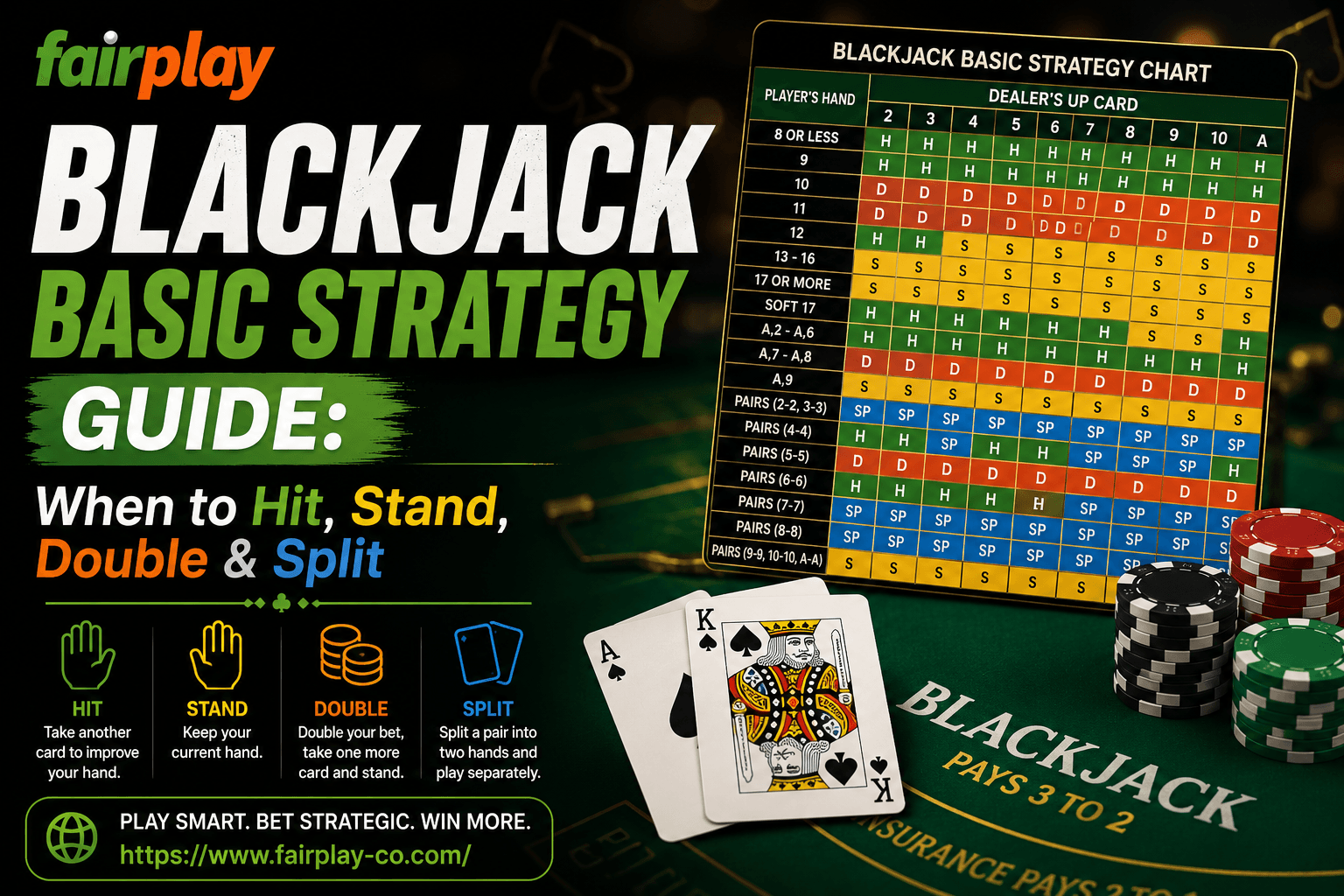
Blackjack is the one casino game where correct play genuinely changes the outcome in a mathematically significant way. Every other table game settles on probabilities that the player can't influence. Blackjack is different. The decisions a player makes during each hand, whether to hit, stand, double down, or split, directly affect the expected outcome. Blackjack basic strategy is the set of decisions that produces the best mathematical outcome for every possible hand combination. Applied correctly, it reduces the house edge on a standard six-deck blackjack game from around 2% down to approximately 0.5%. That's not elimination of the house edge, but it's a meaningful reduction that changes the practical experience of playing the game.
Key Takeaways:
- Blackjack basic strategy is a mathematically derived decision chart that specifies the optimal play for every hand combination
- The strategy accounts for the player's two cards and the dealer's visible upcard simultaneously
- Hard hands (no ace or ace counting as 1) and soft hands (ace counting as 11) require different strategy approaches
- Doubling down and splitting are the two most commonly misplayed decisions among beginners
- Applying the correct strategy reduces the house edge to approximately 0.5% on standard six-deck blackjack
- FairPlay carries live blackjack tables with multiple variants from top providers
Blackjack Rules and Strategy: Understanding the Game First
Blackjack rules and strategy start with the same foundation: the goal is to get a hand value closer to 21 than the dealer's without exceeding 21.
Cards two through ten are worth their face value. Face cards (Jack, Queen, King) are worth ten. An ace is worth 11 or 1, whichever benefits the hand. A hand of ace plus seven is worth either 18 or 8, depending on which value is used.
How to play blackjack starts with a bet placed before the cards are dealt. The player receives two cards face up. The dealer receives two cards, one face up and one face down. The player then decides how to play their hand based on what they can see: their own two cards and the dealer's visible upcard.
After the player's decisions are complete, the dealer reveals their hidden card and plays their hand according to fixed rules. Most blackjack games require the dealer to hit until reaching 17 or above. Understanding that the dealer has no choice in their decisions is important for blackjack rules and strategy because it means the dealer's upcard tells a player a great deal about what's likely to happen next.
Hard Hands in Blackjack Basic Strategy
A hard hand is any hand without an ace, or a hand where the ace must count as 1 to avoid busting. Hard hands are where most of the blackjack basic strategy decisions happen.
Hard 8 or below: always hit regardless of the dealer's upcard. The hand is too low to stand on, and the risk of busting is zero on a single hit.
Hard 9: double down if the dealer shows 3, 4, 5, or 6. Otherwise hit. Dealer upcards of 3 through 6 mean the dealer has a high probability of busting, making doubling profitable.
Hard 10 or 11: double down against most dealer upcards. Hard 11 is one of the strongest doubling hands available. Hard 10 doubles against everything except a dealer ace or ten.
Hard 12 to 16: the most difficult group. These hands bust frequently on a hit but lose to most dealer totals on a stand. Against dealer upcards of 2 through 6, stand. Against 7 or higher, hit. These are decisions that feel uncomfortable but have clear mathematical support.
Hard 17 or above: always stand. Hitting risks busting at a rate that doesn't compensate for the possibility of improving the hand.
Soft Hands in the Blackjack Strategy Guide
Soft hands contain an ace counting as 11. They're more flexible than hard hands because taking a card can never bust a soft hand in a single hit.
This blackjack strategy guide covers the most common soft hands:
Soft 13 to 15 (Ace-2 through Ace-4): hit against most dealer upcards. Double against 5 or 6 when the rules allow doubling on these totals.
Soft 16 or 17 (Ace-5 or Ace-6): double against dealer 3 through 6. Hit against everything else. Soft 17 doubles against more upcards because the hand value is strong enough to benefit from a double.
Soft 18 (Ace-7): This is the hand that beginners most often misplay. Against dealer 2 through 6, double if allowed or stand. Against dealer 7 or 8, stand. Against dealer 9, 10, or ace, hit. Standing on soft 18 against a dealer ten is a common mistake that blackjack basic strategy corrects.
Soft 19 or 20: stand. The hand is strong enough that no adjustment improves expected value.
Splitting in Blackjack
Splitting is available when both cards in the initial hand have the same value. The pair is split into two separate hands, each with an additional card dealt to complete it.
Always split Aces. Two aces form a combined hand of 12, which is weak. Split into two hands starting from ace, each of which can become a strong 21.
Always split 8s. A hand of 16 is the worst hand in blackjack, standing loses to most dealer totals, and hitting busts frequently. Two hands starting from 8 each have better expected outcomes than playing the combined 16.
Never split 10s. A hand of 20 wins most of the time. Splitting gives up a near-certain win for two uncertain hands starting from 10.
Never split 5s. Two fives are best treated as a hard 10 and played as a doubling hand rather than split into two hands starting from 5, which are weak positions.
4s split only against dealer 5 or 6. 2s, 3s, and 7s split against dealer 2 through 7. 6s split against dealer 2 through 6. 9s split against dealer 2 through 6 and 8 through 9, but stand against dealer 7, 10, or ace.
Blackjack Betting Strategy: Managing the Session
Blackjack betting strategy at the session level applies regardless of which specific hand decisions are being made. Flat betting works best for most players: the same stake amount per hand throughout the session. Progressive systems like doubling after losses carry an escalation risk that flat betting avoids.
Set a session budget before the first hand. Decide the maximum loss for the session and stop when it's reached. Set a win target and stop when it's hit. Playing past a profitable session target is the most common reason a winning session becomes a losing one.
Choose tables with player-friendly rules. Blackjack that pays 3:2 on a natural blackjack is significantly better than 6:5 payout tables. A 6:5 table increases the effective house edge by approximately 1.4%, substantially reducing the benefit of correct blackjack basic strategy play.
Blackjack Tips for Beginners Worth Knowing Immediately
Blackjack tips for beginners that apply from the first session:
Never take insurance. Insurance is a side bet that the dealer has blackjack when showing an ace. It pays 2:1, but the house edge on insurance is approximately 7%. No version of blackjack basic strategy recommends taking insurance.
Don't play hunches. The mathematical decisions in blackjack basic strategy are derived from millions of simulated hands. A gut feeling that the dealer is going to bust doesn't override the strategy chart's recommendation. Deviating from basic strategy consistently increases the house edge over time.
Surrender when available. Late surrender, which allows folding a hand for half the stake after the dealer checks for blackjack, is available in many online blackjack variants. Surrendering hard 16 against a dealer 9, 10, or ace, and hard 15 against a dealer 10, is the correct basic strategy play in games where surrender is offered.
Playing Blackjack Basic Strategy on FairPlay
FairPlay is a trusted betting site that hosts live blackjack tables from leading providers including Evolution and Pragmatic Play. Multiple variants with different rule sets are available, giving players the option to find tables with 3:2 natural blackjack payouts and surrender rules that complement correct blackjack basic strategy play.
UPI deposits clear in 60 seconds. IMPS withdrawals average 32 minutes. For blackjack players running flat betting sessions with clear budgets, the fast payment processing means session funds are accessible before and after play without significant waiting periods.
Final Thoughts
Blackjack basic strategy is the single most valuable piece of knowledge a casino player can carry into any live blackjack table. It reduces the house edge to approximately 0.5%, makes every hand decision systematic rather than guesswork, and produces the best possible expected outcome from every card combination. This blackjack strategy guide covers hard hands, soft hands, splitting, and doubling in the framework that mathematics supports. Blackjack tips for beginners that matter most are avoiding insurance, following the strategy chart rather than hunches, and choosing tables with 3:2 natural payouts.