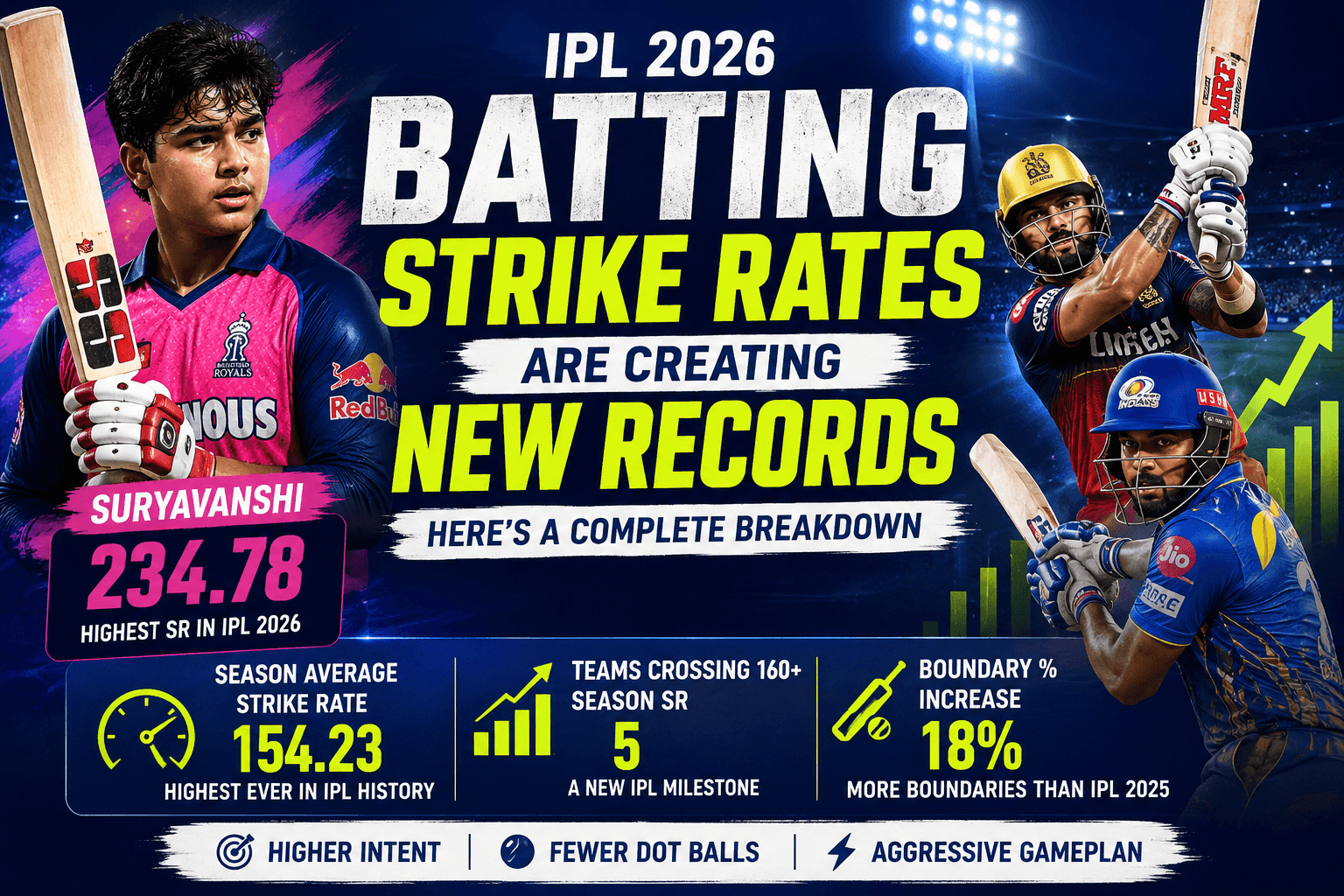
Numbers in IPL 2026 are doing things that would have seemed impossible even five seasons ago. The IPL 2026 stats analysis tells a story of a batting revolution so sharp and so sudden that comparisons to previous seasons barely hold up anymore. This is not a matter of a few big individual innings inflating the averages. The strike rate records being broken this season run from the top of the individual leaderboard all the way down to how the tournament is scoring as a whole, and the data behind it is worth understanding in full.
How the IPL 2026 has reached its highest-ever strike rate?
In the first 63 matches of IPL 2026, teams have scored 13,100 runs at a highest strike rate of 154.17. That is the highest full-season run rate in the tournament's 19-year history, crossing a barrier that has been approached but never broken in any previous edition.
To understand how significant that shift is, the overall strike rate in IPL was 126.3 in 2020, climbed to 133.4 in 2022, reached 141.8 in 2024, and has now jumped to 154.17 in 2026. That is a 22 percent increase in six years - a rate of change that goes far beyond natural statistical drift. Something structural has changed in how the game is being played, and the IPL 2026 batting strike rate data reflects that at every level.
Perhaps the most remarkable single data point from ESPNcricinfo's analysis: in 2008, the highest strike rate in the entire IPL season belonged to Virender Sehwag at 168.42. In IPL 2026, eleven different batters have already surpassed that number across a full season of innings. The baseline of what is considered fast scoring has completely moved.
The Batters Setting Up the Highest Strike Records
The highest strike rate in the IPL 2026 leaderboard, verified from CricTracker and updated as of May 19, 2026, shows just how extreme the top of the table has become. Among batters with meaningful innings totals across the season, the numbers are extraordinary.
Vaibhav Suryavanshi of Rajasthan Royals leads all batters with a minimum of 300 runs this season at a strike rate of 234.78 from 12 matches, scoring 486 runs at an average of 40.50. ESPNcricinfo's smart stats confirmed that his strike rate of 238 across the season is the best recorded by any batter who has scored 300 or more runs in any IPL season across all 460 instances since 2008. That is not a 2026 record. That is an all-time IPL record.
Priyansh Arya of Punjab Kings sits at 212.87 from 12 matches with 364 runs - a number that represents a sharp correction from the 250.4 figure cited in mid-season reports, reflecting some lower-scoring recent innings. Abhishek Sharma of SRH has 507 runs in 13 matches at a strike rate of 201.99, making him the only batter in the tournament's history to score 500-plus runs in a season at a strike rate above 200. Finn Allen of KKR sits at 221.38 from 9 matches with 321 runs, and Tim David of RCB has 262 runs at 196.99 across 12 innings.
What makes this list significant for IPL 2026 player performance stats analysis is not just the top number but the depth of it. Five different batters have maintained a strike rate above 200 across meaningful sample sizes this season. In the entire history of the IPL before 2026, that had happened a combined total of three times across all editions.
Why IPL 2026 Strike Rates Are So Much Higher - The Real Reasons
The data raises an obvious question that the IPL 2026 stats analysis needs to answer: why now? The pitches have not changed dramatically. The ball has not changed. The boundary sizes at most grounds are the same as they have been for years. Three specific structural factors explain most of what is happening.
The Impact Player Rule Is Adding One Extra Aggressive Batter Per Innings
The Impact Player substitution rule, in place since 2023 but now fully embedded into team strategies, allows teams to add a specialist batter as a substitute mid-innings. In practice, this means every team now effectively bats twelve players, with the Impact Player almost always being an additional aggressive batter rather than a bowling option. The result is that teams can send in a batter purely for strike-rate purposes in the final five overs without worrying about their bowling balance. This structural change alone has added an estimated 8 to 12 runs per innings compared to pre-Impact Player seasons, according to CricViz analysis referenced by Gulf News.
A Generation of Indian Batters Trained to Attack From Ball One
The T20 batting strike rate trends IPL data reveal something that has not happened in the tournament's history before. In IPL 2026, Indian batters are scoring at a strike rate of 158.86 while overseas batters are at 144.59. For the first time since 2011, Indian batters are outscoring overseas players in terms of strike rate, and the gap of 14.27 runs per 100 balls is the largest ever recorded. ESPNcricinfo's mid-season analysis attributed this directly to a generation of uncapped Indian batters who have been trained in T20 academies and franchise systems that specifically reward and develop attacking batting from the opening over. Suryavanshi, Arya, Prabhsimran Singh, and Ayush Mhatre represent the first generation produced entirely by this system.
200-Plus Totals Are No Longer Exceptional - They Are Expected
The IPL strike rate records 2026 data sits inside a broader context of escalating totals. The 200-plus score has been posted 36 times in the first 63 matches of IPL 2026, compared to 19 times across all 74 matches of IPL 2024. Teams are not just scoring faster - they are consistently hitting totals that would have been considered outstanding five years ago. That changes how every team approaches their batting, because the target a team is trying to set or chase has shifted upward, which in turn forces higher individual strike rates throughout the lineup. It is a self-reinforcing cycle, and 2026 is the season where it has hit its most extreme expression yet.
The Innings That Best Explain the IPL Strike Rate Records 2026
Individual innings tell the story more vividly than season aggregates. Suryavanshi's 103 off 37 balls against SRH at Jaipur - the third fastest century in IPL history - included 12 sixes and four fours, with five maximums hit off the very first six balls he faced. His strike rate in that innings was 278.4. His 26-ball 78 against RCB produced a strike rate of 300 and was rated as one of the ten best individual innings of the season by ESPNcricinfo's impact model, despite not being the highest score. The DC vs RCB match produced the contrast that defines the season: RCB's Phil Salt and Rajat Patidar scored at a combined strike rate of over 180 while building their total, while DC's entire top order collapsed in the powerplay with a combined strike rate of under 50 across their six-wicket loss. The difference between a strike rate of 180 and 50 in the power play is not just a number. In IPL 2026, it is the difference between 222 and 75.
What These Strike Rate Trends Mean for IPL 2026 Session Betting
Understanding IPL 2026 batting strike rate trends at a granular level is directly valuable for session betting, because the session lines that bookmakers set are calibrated against historical scoring patterns. When those patterns shift as dramatically as they have in 2026, the lines do not always catch up fast enough with reality. A powerplay line of 52 set against a team opening with Suryavanshi or Abhishek Sharma on a flat Wankhede surface should, based on this season's data, be read very differently from the same line against a team opening with more conservative batters on a slow Chepauk pitch.
The strike rate data also creates specific angles in player runs markets. A batter with a season strike rate above 200 facing a spinner who has been bowling at an economy of 9.5 represents a different value proposition than the same batter facing Bhuvneshwar Kumar at 7.40. Matching individual strike rate data with bowling matchups is where the real edge sits in IPL fancy betting markets, and the depth of IPL 2026 player performance stats available this season makes that analysis more precise than it has ever been before.
FairPlay offers live sessions, and players run markets on every IPL 2026 playoff match with ball-by-ball odds that reflect in-play conditions. If you want to apply this strike rate analysis to real betting decisions, FairPlay's IPL 2026 section has the full range of markets available through to the May 31 final in Ahmedabad.
Final Thoughts on IPL 2026 Stats Analysis and the Strike Rate Revolution
The IPL 2026 stats analysis on batting strike rates tells a story that goes beyond individual brilliance. Eleven batters surpassing Sehwag's 2008 season strike rate. Indians outscoring overseas players for the first time in over a decade. Five batters sustained a strike rate above 200 across meaningful sample sizes in a single season for the first time. These are not minor fluctuations. They represent a fundamental shift in how T20 cricket is being played, led by a generation of Indian batters who have been built specifically for this format and this era. The records being broken in IPL 2026 will set the benchmarks that future seasons are measured against, and based on the trajectory of the last five years, it is hard to see where the ceiling actually is.